


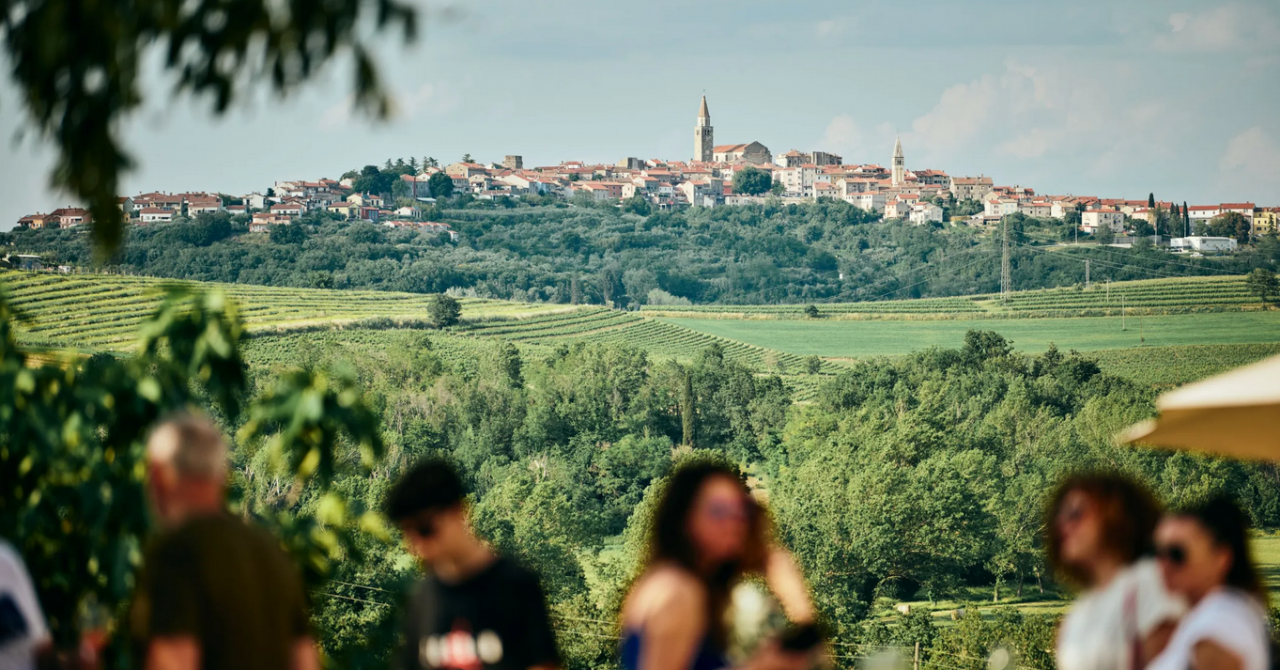
There is a particular moment in Istria that you don’t quite expect the first time you visit. You’re driving along a ridge road somewhere between Motovun and Grožnjan, the sun still low and the morning mist sitting in the valleys like it hasn’t decided to leave yet, and you pull over — not because anything is wrong, but because everything is right. The vines are perfectly trained along the red-orange earth. A bell tower rises from a hilltop village that looks more Tuscan than anything on the Adriatic coast. The smell of oak forest and wild herbs drifts through the open window. And somewhere in the back of your mind, you realise: this is one of the most underestimated wine regions in the whole of Europe.
Istria is Croatia’s northwestern peninsula, jutting into the northern Adriatic between the Gulf of Trieste and the Kvarner Bay. It is a place shaped by centuries of Venetian rule, Austro-Hungarian ambition, and an Italian cultural imprint so deep that many locals still speak Istrian Italian alongside Croatian. All of this history — the competing influences, the borderland identity, the defiant Mediterranean spirit — finds its way, inevitably, into the wine.

The Terroir: Red Earth, White Stone, Sea Air
Istria’s geology is its first gift to the winemaker. The peninsula divides itself into two distinct zones that wine lovers quickly learn to navigate. The western coast, from Poreč down through Rovinj and Pula, is dominated by terra rossa — that iron-rich, deep red clay soil that is immediately striking even when you’re simply standing on it. Vines planted here dig down through the red earth and into limestone beneath, producing wines with structure, warmth, and a mineral tension that takes your breath away. The interior hills, particularly around Motovun, Buzet, and the so-called Istrian heartland, offer cooler conditions, higher elevation, and soils that shift toward grey marl and lighter limestone — ideal for preserving aromatics and acidity.
The climate is firmly Mediterranean along the coast, with warm, long summers and mild winters softened by the Adriatic. Inland Istria is a touch cooler, where the bura wind — that cold northeastern blast well known across the Croatian coast — occasionally provides welcome relief in the growing season and helps keep disease pressure low in the vineyards. Average annual sunshine exceeds 2,500 hours across the peninsula, and while summers are reliably hot, the diurnal temperature swing inland ensures that grapes hold onto their freshness through the ripening period. It is the kind of climate that makes winemakers smile when they talk about it, and visitors understand why the moment they taste the results.
Malvazija Istarska: The Soul of a Peninsula
If you are visiting Istria for the first time, your introduction to its wine will almost certainly begin with Malvazija Istarska. This is the grape that defines the region — not in the way that Bordeaux is defined by Cabernet Sauvignon, as something serious and formal, but in the way that a coastline is defined by its light. Malvazija is everywhere and yet never quite predictable.
Genetically distinct from the many other Malvasias found scattered across the Mediterranean, Malvazija Istarska produces whites of remarkable personality. At its most expressive, it offers a nose of white peach, yellow flowers, a hint of beeswax, and then that unmistakeable saline mineral quality that seems to carry the smell of the Adriatic directly into the glass. In the mouth it is medium-bodied, fresh, with just enough weight to feel satisfying with food and just enough acid to make you reach for another sip. The finish often leaves behind a faint bitter almond note — very Italian, very coastal, very much Istria.

What makes Malvazija particularly fascinating today is the divergence of styles on offer. Some producers keep it lean, stainless steel only, bottled young and drunk at the kind of crisp temperature that feels like swimming in the sea. Others age it in large oak barrels or on the lees for extended periods, bringing out a richer, more textured expression that pairs beautifully with the white truffles Istria is equally famous for. And then there is the amber wine movement, gaining momentum especially among younger winemakers — extended skin-contact Malvazija that takes on a deeper golden colour, tannin structure, and an oxidative complexity that challenges everything you thought you knew about this grape.
Teran: Blood Red and Beautifully Difficult
Istria’s great red is Teran, and it is not a grape for the faint-hearted. Grown almost exclusively on the red soils of the Istrian plateau, Teran produces wines of intense, almost shocking colour — deep ruby-crimson that looks nearly black in the glass. The nose is wild: dark cherry, iron, earth, sometimes a flinty smoke that reminds you there is something ancient about this variety. On the palate, the tannins arrive quickly and the acidity is high, almost electric. In the wrong hands, Teran can seem harsh. In the right ones, it is extraordinary.
Historically, Teran was the wine of the Istrian farmer — high in iron, full of energy, drunk young and drunk with food. The local saying that it is the wine of health is no mere folk wisdom; Teran genuinely has some of the highest natural iron content of any wine grape in Europe. Today’s best producers balance that raw power with careful viticulture, extended maceration, and judicious oak ageing to produce Terans of real depth and longevity. The local dish of choice is fuži s trtufima — the handmade Istrian pasta with truffle — or a slow-roasted lamb from the interior hills. Teran, it turns out, was made for exactly this kind of table.
Wineries Worth Seeking Out
The Istrian wine scene rewards those who are willing to venture beyond the obvious. Driving the peninsula’s back roads — without a rigid itinerary, stopping when a hand-painted sign catches your eye — is genuinely the best approach. That said, there are producers whose wines have put Istria on the international map and whose cellars deserve your time.
Kozlović winery, based near Momjan in the northern part of the peninsula, is perhaps the most internationally recognised name. Their Santa Lucia Malvazija is considered by many to be a benchmark expression of the variety — elegant, precise, with genuine ageing potential. The family winery has been producing wine for generations and the cellar visits feel unhurried, personal, and deeply rooted in the place.
Roxanich, just outside Motovun, occupies a different philosophical space entirely. Mladen Rožanić is one of Istria’s most committed natural winemakers, and his cellar is a museum of long maceration, minimal intervention, and extraordinary patience. His Antica Malvazija — amber wine aged for years in old barrels — is unlike anything else produced in Croatia. It demands your full attention.
Clai winery in Brtonigla is another name that resonates strongly in natural wine circles internationally. Giorgio Clai has been farming biodynamically for decades and his wines carry that specific quality of being absolutely rooted in their landscape — you taste the red earth, the sea breeze, and the wild herbs of the Istrian macchia in every glass. His Ottocento Teran is a wine that divides opinion and creates devotion in equal measure.
For those who prefer a more classical, polished approach, Matošević near Labinci produces technically impeccable wines, particularly their Alba Robinia — a barrel-fermented Malvazija of great precision and length. And on the Poreč side of the peninsula, the large-scale cooperative Agrolaguna is worth knowing simply because it manages, at significant production volumes, to bottle wines that genuinely represent the region with honesty.
The Table That Comes With the Glass
Istrian wine without Istrian food is only half a story. The cuisine here is among the most quietly sophisticated in all of Croatia — building on Venice’s historical shadow, the Austrian love of ingredient quality, and the Mediterranean abundance of olive oil, seafood, and cured meat. White truffles from the Motovun forest, harvested from October through December, are the region’s most celebrated luxury and one of the finest possible companions for a glass of aged Malvazija. Black truffles are found throughout the year and turn up in everything from scrambled eggs in the morning to pasta at lunch.
The olive oils of Istria have been winning international awards for years and deserve as much attention as the wines. The local prosciutto — pršut istarskog tipa — is dry-cured and nutty, paper-thin when sliced properly, and extraordinary with a young, cold Malvazija on a summer afternoon. Along the coast, oysters from the Lim fjord south of Rovinj are an argument for visiting Istria by themselves. Paired with a mineral, sea-salted Malvazija from the western coast, the effect is near-perfect.
When to Go and How to Move
The wine traveller’s ideal window for Istria falls in September and October. The summer crowds have thinned, the light has taken on that golden, lower-angled quality that photographers love, and the vineyards are at their most alive — workers moving between the rows, the smell of freshly crushed must drifting from open cellar doors, harvest lunches that spill from midday to late afternoon with no particular urgency. If you have any flexibility at all, come in autumn.
The peninsula is compact enough to explore without exhaustion. Staying centrally — in Motovun, Grožnjan, or the larger coastal towns of Rovinj and Poreč — puts you within thirty to forty minutes of almost anywhere you might want to go. A rental car is essential; the best producers are on country roads, and the landscape between them is as much of the experience as the wine itself. Give yourself at least four days and resist the temptation to over-schedule. Istria rewards wandering.
A Region That Has Found Its Confidence
What strikes you most about Istria’s wine world today is not the quality — though that is genuinely impressive — but the confidence. A generation ago, much of Istria’s wine was sold in bulk, consumed locally, or never thought about beyond the peninsula. Today, producers here are showing at the world’s most discerning natural wine fairs, winning awards in international competitions, and building devoted followings among the kind of wine drinkers who travel specifically to find something they cannot get at home.
That confidence shows in the wines themselves. There is less anxiety now about whether Malvazija Istarska needs to be compared to white Burgundy to be taken seriously, or whether Teran needs to be softened to appeal to international palates. The best Istrian producers are leaning into what makes their wines unique — the red earth, the sea air, the wild herbs, the ancient varieties — and the results speak for themselves. This is a wine region that knows exactly who it is, and is very glad you’ve come to visit.